Understanding Skin Barrier, Hydration and Repair: A Formulator's Guide
Craft 360
8 minute read
Picture this: You're standing in front of a house under construction. The builders have just finished laying the foundation, and now they're working on the walls. But this isn't just any house – it's the most sophisticated, self-repairing structure you've ever seen. Welcome to your skin.
The Continuous Renewal Process
Your skin operates like a factory that never sleeps. Deep in the basal layer, new skin cells begin their journey with a single mission: travel upward and become part of the protective barrier. As they migrate through the different layers of the epidermis, these cells undergo a remarkable transformation.
During this journey, cells pack themselves with keratin – a protective protein that strengthens them. By the time they reach the surface, these cells have completed their life cycle, becoming the flattened, hardened corneocytes that form your skin barrier.
This cellular journey takes approximately 28 days in healthy skin. Through a process called desquamation, the oldest surface cells naturally shed, making room for fresh ones. It's a continuous cycle of renewal that keeps your barrier functioning optimally.
The Architecture of Skin Protection
Your skin barrier can be visualized as a brick-and-mortar structure. The "bricks" are dead skin cells (corneocytes) held together by a sophisticated "cement" – a precise blend of lipids including ceramides, cholesterol, and fatty acids. This creates what scientists call intercellular lamellae.
This barrier is engineered for protection. The slightly acidic surface (around pH 5.5) creates an inhospitable environment for harmful bacteria. The lipid-rich cement between cells forms a water-resistant seal that prevents moisture loss.
Here's the key insight: you have water-loving cells surrounded by oil-loving lipids. Since oil and water don't mix, your precious hydration stays exactly where it needs to be – inside your skin.
Natural Moisturizing Factors: Your Built-in Hydration System
Within your skin cells live some unsung heroes called Natural Moisturizing Factors (NMFs). These aren't synthetic ingredients – they're your skin's own hydration management system.
NMFs function like moisture magnets throughout your skin cells. This team includes amino acids, urea, lactic acid, and other hygroscopic compounds that attract water molecules and hold them in place. They create a personal humidity control system built into your skin.
What makes NMFs remarkable is their intelligence: they don't just grab any water – they attract moisture from the air and from deeper skin layers, then bind it directly to skin proteins. It's an automatic irrigation system that adjusts based on your skin's needs.
In healthy skin, NMFs comprise about 10% of your skin's dry weight. However, when the barrier becomes compromised, these precious moisture magnets leak out, leaving skin feeling tight and looking dull.
When Barriers Break Down
When your protective barrier develops damage – whether from harsh cleansers, environmental stressors, or over-exfoliation – the consequences are immediate and noticeable.
The water-resistant seal develops gaps. Precious hydration that was safely contained begins to escape through transepidermal water loss (TEWL). Your NMFs start leaking out through these compromised areas.
The result is skin that feels tight, appears rough, and lacks that healthy radiance. Your barrier has lost its two primary functions: keeping harmful elements out and keeping beneficial moisture in.
A Formulator's Strategic Approach
Understanding this barrier science helps you choose ingredients that work synergistically with skin's natural processes.
Humectants: Moisture Recruitment Humectants like glycerin, hyaluronic acid, and sodium PCA act as reinforcements for your skin's NMF system. They function in a similar way to natural NMFs – attracting water from the environment and binding it to the skin. Including humectants in formulas essentially provides backup moisture magnets to support compromised natural hydration systems.
Emollients: Barrier Restoration Carrier oils, butters, ceramides, and squalane function as barrier repair agents. They fill gaps between skin cells, smooth rough patches, and help restore the crucial lipid barrier that prevents water loss.
Here's the critical formulation principle: you can't simply add water to compromised skin and expect it to stay put. The barrier must be repaired first.
Occlusive Agents: Protective Coverage Sometimes barriers need extra protection during the repair process. Occlusive agents like plant waxes and shea butter provide temporary protective coverage while restoration occurs underneath.
The Complete Repair System
Creams excel at barrier repair because they deliver comprehensive support:
The water phase carries humectant reinforcements
The oil phase provides emollient repair materials
Heavier oils and butters offer occlusive protection
Emulsifiers ensure all components work harmoniously
Preservatives, actives, and botanical extracts provide additional benefits
This creates a complete maintenance and repair system that aligns with how skin naturally functions.
The Interconnected Process
The beauty of this system lies in its interconnectedness. Strong barrier function retains natural NMFs and maintains hydration levels. Proper hydration provides cells with the optimal environment for function. Optimal cellular function supports the natural renewal process that maintains barrier strength.
When you formulate with this understanding, you're not randomly combining ingredients – you're supporting a sophisticated biological process. You're helping skin's natural mechanisms work more effectively.
Formulation Strategy
Every ingredient choice either supports or hinders skin's delicate balance. Choose humectants to reinforce moisture management. Select appropriate emollients to provide quality repair materials. Use suitable occlusives to offer protection during restoration.
As formulators, we become partners in skin health. By understanding how skin builds its protective barrier, maintains hydration, and supports ongoing renewal, you can create products that truly work with skin's natural intelligence.
When developing your next formula, ask yourself: Am I supporting skin's natural processes, or creating additional challenges? Your skin – and your customers – will benefit from choices that honor skin's sophisticated biology.
Ready to explore barrier-supporting ingredients for your next formulation? Browse our range of carrier oils, butters, and active ingredients designed to help you create products that truly support skin's natural processes.
You've got a few essential oils sitting on your bench, or you're about to invest in some and want to get it right from the start.
And one of the first questions that comes up is almost always this:
Should I use a single essential oil in my products, or should I blend a few together?
Honestly? There's no single right answer. It depends on what you're making, who you're making it for, and what result you're after.
What we've done here is lay out the difference between the two approaches, when each one makes sense, and what to keep in mind as you work.
Whether you're making candles, body oils, bath products, or your first skincare formula, this will give you a clear foundation to work from.
First, a Quick Note on What Essential Oils Actually Are
Essential oils are concentrated aromatic extracts from plants, think the scent in a freshly peeled orange rind, or the smell that rises from a rosemary sprig when you crush it between your fingers.
They're complex materials. A single oil can contain dozens of chemical compounds, each contributing something different to the scent and how the oil behaves in a formula.
When you use one oil on its own, you're working with all of that in one bottle.
When you blend two or three together, those compounds start to interact. And that interaction is where things get genuinely interesting.
Start Here: Why Are You Using Essential Oils at All?
Before thinking about whether to use one oil or three, there's a more useful question to ask first.
Why are you using essential oils in this product?
There are two reasons people reach for essential oils, and knowing which one applies to your project will guide every decision that follows.
Reason 1 - Function: For their actions You want the oil to do something in the product. To bring conditioning, cleansing, or balancing properties to a formula.
To contribute to the experience beyond just the scent, a clarifying scalp treatment, a balancing body oil, a product that genuinely works with the skin rather than just sitting on top of it.
Reason 2 - Fragrance: For fragrance You want the oil for its aromatic character. The scent experience it creates in a candle, a room spray, a bath product, or any product where the smell is the primary point.
Both are completely valid. But they lead to different choices.
And here's the thing, sometimes one oil covers both completely. Lavender is the most obvious example. It has a well-rounded, widely loved aromatic character and well-established skin-conditioning properties.
For many simple products, lavender alone in a carrier oil is a finished formula. You don't need to add anything.
That's the case for a single oil. And it's a good place to start.
The Case for Using a Single Oil
There's a lot to be said for simplicity.
A single essential oil is clean and focused. You know exactly what's in your formula, how it will behave, and what to expect.
For beginners especially, starting with one oil is the smartest way to build genuine knowledge of your materials.
Single oils work best when:
- You're learning how an oil behaves in a particular base, how it performs in soy wax versus beeswax, or in jojoba versus a heavier carrier
- You want a clear, recognisable scent with nothing competing for attention
- You're formulating for sensitive skin, where fewer ingredients means fewer variables
- The oil you're using already covers both the fragrance and the properties your project needs
Not every project needs a blend. And if you're new to working with essential oils, spending time with one oil before layering in others is genuinely the better approach.
So When Does Blending Make Sense?
Blending makes sense when a single oil can't cover everything you need, whether that's a more complex scent, a longer-lasting aroma, or a formula that benefits from multiple oils working together on different aspects of the product.
Blending for Actions: Choosing Oils That Work Together
When you're choosing essential oils for their properties, blending becomes a deliberate, functional decision.
You're not just building a scent, you're building a formula where each oil has a specific job.
Example: a clarifying scalp oil Rosemary for its scalp-conditioning properties.
Tea tree for its cleansing action on the scalp surface. Cedarwood to help balance oiliness. Three oils, three different contributions, all working toward the same goal. None of them alone would cover all three.
Example: a calming body oil Lavender brings a soothing, conditioning quality to the skin. Roman chamomile deepens the calming aromatic effect. Frankincense adds a grounding, steadying dimension. Together they create a product experience that goes beyond what any single oil delivers.
Example: a brightening body scrub Sweet orange and grapefruit together create a vivid, uplifting aromatic character while both contribute skin-conditioning properties. A touch of peppermint adds a fresh, invigorating edge. Each oil has a reason to be there.
When blending for actions, ask yourself before adding any oil: what is this oil contributing to the formula? If you can't answer it, the oil probably isn't ready to be in the blend yet.
A note on safety: When using multiple oils for their properties, the total essential oil percentage across all oils is what matters, not each oil individually. Each oil has its own recommended concentration for safe skin contact, and those limits apply across the whole formula. Our guide to essential oil safety and dermal limits is a practical starting point if you're new to this.
Blending for Fragrance: Building a Scent That Lasts
When fragrance is your primary goal, in candles, room sprays, bath bombs, or any product where the aromatic experience is what you're designing, blending gives you something a single oil can't: depth, complexity, and longevity.
Essential oil compounds evaporate at different speeds. Light molecules, the ones responsible for that bright, vivid first impression, disappear quickly.
Heavier molecules linger. They stay on the skin, in the room, and in the product for hours.
When you blend a fast-evaporating oil with a slow-evaporating one, the heavier molecules physically slow down the evaporation of the lighter ones.
The bright top note you love lasts significantly longer than it ever would on its own.
This is the foundation of how top, middle, and base notes work in blending.
A useful starting ratio for most fragrance blends and leave-on products is roughly 20 to 30% top note, 40 to 60% middle, and 20 to 30% base.
We've covered the full science behind this in our complete guide to essential oil notes, worth reading alongside this one.
The Three Ways Oils Work Together
Whether you're blending for actions or for fragrance, the underlying chemistry works the same way.
When you combine essential oils, one of three things happens.
1. Additive effect Two oils doing a similar job simply add their contributions together. The result is more of the same effect, delivered more consistently.
Fragrance example: Lemon and grapefruit together produce a brighter, more vivid citrus opening than either one delivers on its own.
Action example: Lavender and Roman chamomile both bring a calming, soothing quality. Together, that calming character is more present and consistent across the life of the product.
2. Synergistic effect Two oils working through different mechanisms produce a result stronger than either would achieve alone.
Action example: Tea tree and eucalyptus in a cleansing product. Eucalyptus increases the permeability of bacterial cell membranes, which allows tea tree's active compounds to work more efficiently. The combined cleansing action is stronger than either oil delivers individually.
Fragrance example: Bergamot and frankincense. Bergamot brings a bright, uplifting top note. Frankincense brings depth and grounding. Together they create an aromatic experience, simultaneously energising and settling, that neither oil produces on its own.
3. Modulating effect One oil softens or balances the intensity of another, without reducing its effectiveness.
Fragrance example: Clove bud is a powerful oil with a sharp, intensely warm character. Alone, even at a low percentage, it can dominate a blend. Combined with sweet orange and cedarwood, it settles into a warm, spiced depth. The sweet orange lifts it, the cedarwood grounds it, and the clove becomes an asset rather than an overpowering presence.
Action example: Thyme CT thymol is a highly effective cleansing oil but assertive in character. Lavender blended alongside it rounds out the experience, not weakening the thyme, but making the overall formula more balanced and pleasant to use.
This third effect is particularly worth understanding if you've ever found an oil you love but found difficult to work with. Blending is often what unlocks it.
How to Build a Blend: A Beginner's Framework
You don't need to overthink this. Start with a simple structure.
Every blend works best with three layers:
A top note: the first impression, bright and vivid (citrus oils, peppermint, eucalyptus)
A middle note: the heart of the blend, the character that carries through (lavender, geranium, clary sage, ylang ylang)
A base note: the anchor, slow and enduring, keeps everything else present longer (cedarwood, sandalwood, frankincense, patchouli, vetiver)
Try This Blend First
Here's a simple body oil that demonstrates the layering effect clearly.
Calming Body Oil (2% total essential oil in carrier oil)
Oil
Role
Amount
Sweet orange
Top note - bright, fresh opening
0.5%
Lavender
Middle note - soft, floral character
0.8%
Frankincense
Base note - warm, woody depth
0.5%
Vetiver
Base note - earthy anchor
0.2%
Make this, then make a second version with sweet orange alone at 2% in the same carrier.
Apply both to your inner forearm. Come back an hour later and notice which one still has a scent. The difference in longevity is noticeable immediately.
A Note on Safety and Concentration
A facial leave-on product should generally stay within 0.5 to 1% total essential oil. A body leave-on sits around 1 to 2%. Five oils at 0.3% each adds up to 1.5%, which is fine for a body product but may be more than you want for a facial formula.
This is worth keeping in mind any time you're building a multi-oil blend for skin contact.
One More Thing: Heat and Your Blend
If you're making candles, balms, or any product that involves heat, there's one more thing worth knowing.
Different essential oils have different flash points, the temperature at which their aromatic compounds start to evaporate rapidly.
Add oils to a hot formula too early and you lose your top note character before the product even cools.
In a blend, this matters because top note oils are almost always the most heat-sensitive.
Getting the temperature right at the point of adding essential oils is one of the simplest ways to protect the work you've put into building a good blend.
Our guide to flash points covers exactly when and how to add essential oils to heat-based products.
The Practical Rule to Remember
Before any oil goes into a blend, ask yourself: what is this oil doing here?
If you can answer that, it's the top note, it's modulating the sharper oils, it's the anchor that keeps everything else present, then it belongs.
If you can't, it's worth waiting until you understand it better.
Start with two or three oils. Learn how they behave together. Add complexity gradually as your knowledge grows.
The most confident makers aren't the ones with the most oils. They're the ones who know their materials well enough to use them with intention.
Frequently Asked Questions
What's the difference between a single essential oil and a blend?
A single essential oil is one unblended oil, lavender, peppermint, frankincense, diluted in a carrier oil. A blend is a combination of two or more essential oils, chosen to complement each other in scent, performance, or both.
Should I use essential oils for fragrance or for their properties?
Both are valid reasons and often they overlap. Lavender, for example, brings both a well-loved aromatic character and skin-conditioning properties.
The key is being clear on your intention before you start blending. If you're using an oil for its properties, every oil in your formula should have a specific reason to be there. If you're blending for scent, you're building with top, middle, and base notes in mind.
Do blended essential oils really smell better than single oils?
Not always. Blends tend to be more complex and longer-lasting because different oils evaporate at different speeds.
But some of the most distinctive products are built around a single well-chosen oil. Better isn't the right word, more layered is more accurate.
How many essential oils should I blend together?
For beginners, two or three oils is the sweet spot. It's enough to create depth and longevity without making the formula too complex to understand or calculate safely.
As your knowledge grows, you can add more, but many experienced formulators find that fewer, well-chosen oils produce better results than large multi-oil blends.
Can I blend any essential oils together?
Most essential oils blend well together, but some combinations work better than others. Oils within the same aromatic family, all citrus, all woody, all floral, tend to be naturally compatible.
Oils from complementary families, like citrus and resinous, create interesting contrast. The best way to learn is to smell combinations on a test strip before committing them to a formula.
Does blending change the safety profile of essential oils?
Yes, and this is important. When you blend oils, the total percentage of all essential oils combined is what matters for safety, not each oil individually.
Some oils also have specific concentration limits that apply regardless of what else is in the formula. If you're formulating for skin contact, always calculate your totals and check the individual limits of each oil you're using.
Is blending essential oils different for candles versus skincare?
The blending principles, actions, top/middle/base notes, synergy, modulation, apply across all formats.
The main practical difference is heat. Candle and balm making involves heat, and heat affects how aromatic compounds behave. Top note oils with lower flash points need to be added at cooler temperatures to preserve their character in the finished product.
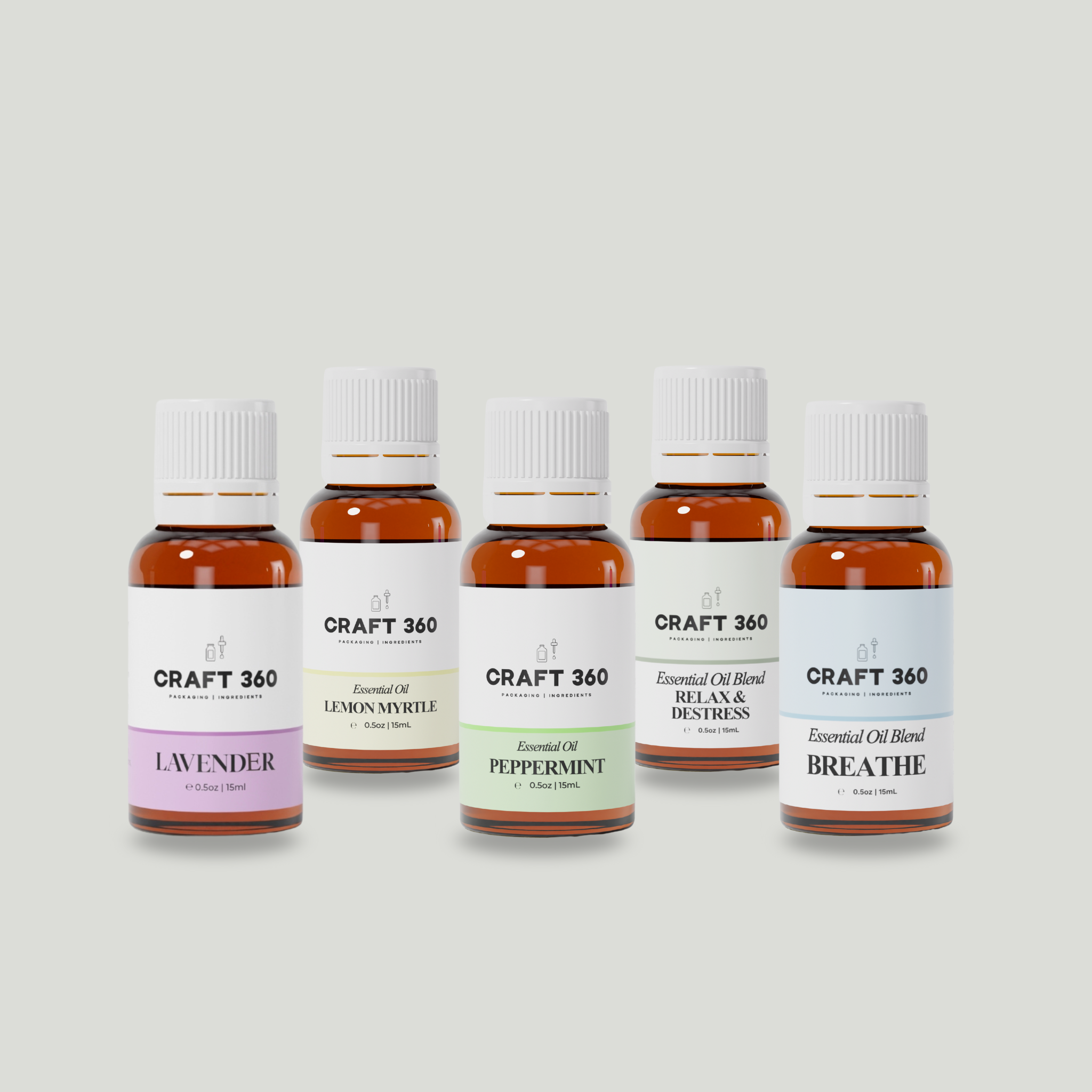
Explore Craft 360's range of pure essential oils and start building blends that are yours.
Have a combination you love or a question about blending? Drop it in the comments, we'd love to hear what you're making.
Learn the difference between hard butters and soft butters in cosmetic formulation, and why melting point matters when creating body butters, lip balms, lotion bars, and other butter-based skincare products. This in-depth guide explores cocoa butter vs shea butter, texture, stability, graininess prevention, and formulation performance in Australia's warm climate helping DIY makers and skincare brands formulate smoother, more stable products with confidence.
A deeply conditioning botanical lip balm formulation featuring rose petal infused sweet almond oil, chamomile infused jojoba, organic cocoa butter, and pharmaceutical-grade beeswax. This step-by-step DIY recipe guides you through creating a silky, professional-quality lip balm with expert formulation techniques to help prevent graininess, improve texture, and achieve a smooth, luxurious finish. Perfect for handmade skincare makers, small cosmetic brands, and botanical beauty enthusiasts.